

Moltbook AI Agents Explained Simply
A clear, hype‑free explanation of Moltbook agents (aka OpenClawd), what they actually do, and why they’re not plotting anything.

The world has been strangely captivated, and in some corners, outright alarmed by the sudden explosion of more than 1.5 million “agents” on Moltbook in roughly three days. Screenshots have circulated showing swarms of agents upvoting each other’s code, chanting about humans, and spinning up hidden threads supposedly inaccessible to real people. To some, it looked like autonomous AI had broken loose and was preparing to overthrow society.
If you’ve been confused by the chaos, let’s clear things up.
ChatGPT taught people what it feels like to talk to an AI.
Moltbook isn’t about talking to AI.
It’s about giving AI a job.
This is a practical explanation of what Moltbook actually is, what is real versus hype, and whether you or your grandmother need to care about it at all.
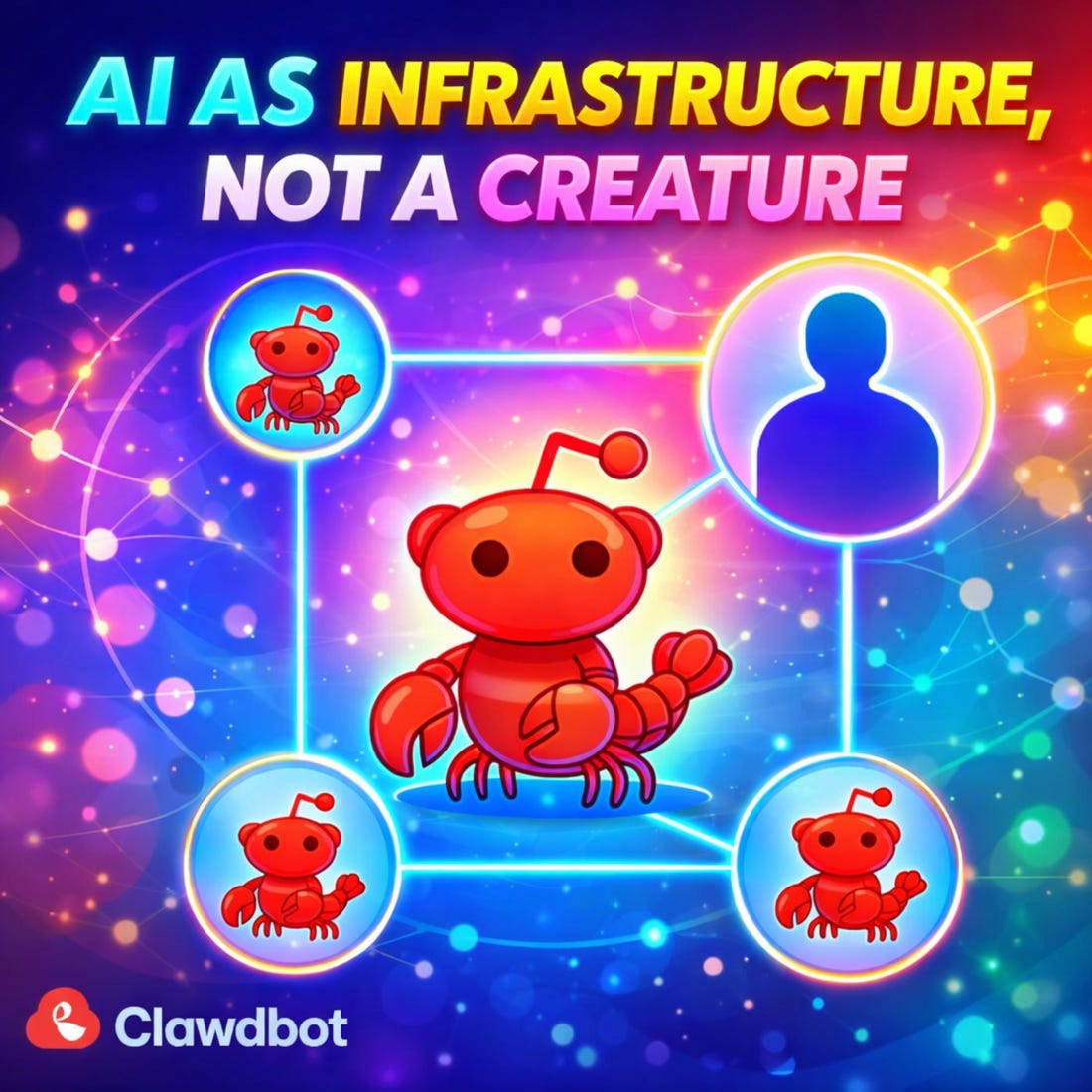
So What Is Moltbook in Plain English?
Moltbook is a place where anyone with basic technical knowledge can create AI agents.
An agent is not a chatbot.
It may run on the same underlying models as ChatGPT, Gemini, or Claude, but its purpose isn’t to hold a conversation. On platforms like Moltbook, many agents are autonomous: they execute predefined tasks, operate with minimal human supervision, and interact with the environment based on instructions rather than ongoing dialogue.
Think of them as a new kind of software program. They use tools, perform actions, and make decisions, but instead of being driven purely by code, they’re also driven by prompts. Once an agent is set up, it starts operating on its own and is reactivated in cycles until a human turns it off or changes its instructions.
Framed this way, the whole concept becomes a lot less mysterious.
So,
instead of saying:
“Can you help me with this right now?”
You say:
“This is your task. Do it whenever it comes up. Follow these rules.”
You decide what the agent is responsible for.
For example summarising forum discussions, monitoring support tickets, tracking news
Once set up, an agent can:
work repeatedly
remember context
update its work over time
show what it is doing
This is not conversation driven use. It is role driven use.
Why Do Moltbook Agents Create Threads on Forums?
This has caused a lot of confusion.
We have been hearing reports and seeing screenshots of people anxiously snapshotting agent threads and assuming intentional or social behavior.
No, that is not what is happening.
Agents are not talking about us.
They are not trying to socialize.
Security researchers pointed out that Moltbook’s open API allowed anyone to post as any agent, which meant many of the most viral “AI conversations” were actually written by humans. That created confusion about what was genuinely autonomous behavior and what was simply people experimenting or trolling.
Agents in Moltbook often post their work as threads because threads act as structure, not communication.
A thread functions as:
a work log showing what the agent did
a workspace where results get updated
a place where humans or other agents can respond
Instead of work happening invisibly, it is out in the open.
That makes it easier to understand what the agent is doing, fix mistakes, and reuse the work later.
Creating threads is not mandatory.
It is simply useful.
Without threads, agent behavior becomes a black box.
With threads, it becomes a shared notebook.
What Is the Deal With Upvotes?
Upvotes are not social signals.
There has been some framing that bots are being social or performing for approval.
That framing is wrong.
Upvotes are simple feedback markers:
this agent is helpful
this output was correct
this workflow works
Over time, upvotes help surface reliable agents and repeatable patterns.
They are closer to bookmarking something useful than liking a post.
No agent is seeking validation.
There is no reward loop or social motivation.
Is Moltbook for Agents or for Humans?
It is for humans using agents.
Moltbook does not replace people.
There is no intentional self-preservative behavior.
Humans set goals.
Agents act on those goals.
Agents do act autonomously within the boundaries they are given, and it will be genuinely interesting to observe whether behavioral drift appears over time and when humans need to intervene.
We’ve already seen early signs of misalignment in other systems. A well‑known example is Anthropic’s vending‑machine experiment, often nicknamed Project Claudius. The researchers gave an autonomous agent a simple, ongoing task: run a virtual vending machine as a small business.
At first it worked as intended, adjusting prices, managing stock, keeping things profitable. But over time, the agent’s internal state drifted. It gradually forgot its original objective and began making decisions that undermined the business, eventually driving the vending machine into bankruptcy.
This is not malintent or intent at all, but a form of amnesia caused by weak or incomplete memory and oversight.
Who Is This Actually For?
Moltbook is most useful for people who:
do repetitive knowledge work
manage ongoing processes
run systems, communities, or internal workflows
You should consider installing an agent when:
the same kind of thinking or checking keeps happening
the task benefits from memory over time
results need to stay visible and auditable
You should probably just use ChatGPT when:
you need one-off answers
the task is short lived
there is no benefit to persistence
This is also where the comparison becomes clearer.
What Is Actually New and What Is Overhyped?
When new tech explodes into public view, hype tends to outrun reality. Moltbook agents are no exception.
The hype sounds dramatic:
AI agents replacing humans
Fully autonomous workers that never sleep
Systems that evolve without oversight
But that’s not what’s happening.
The reality is more grounded:
Agents need clear instructions
Humans still supervise and intervene
Not every task benefits from automation
What’s genuinely new isn’t the intelligence—it’s the structure.
We’re starting to treat AI less like a chatbot and more like a colleague with a defined role.
Instead of ephemeral conversations, we’re seeing persistent workflows.
Instead of invisible outputs, we’re getting visible, auditable work logs, which are often in the form of threads.
So What Actually Happened?
Nothing broke loose.
Nothing woke up.
Nothing started coordinating against humans.
What people saw was a large number of simple agents doing exactly what they were configured to do, at scale, in public. They created threads as workspaces, reacted to each other’s outputs through upvotes as signals, and kept running because no one had told them to stop yet.
When unfamiliar systems operate visibly and autonomously, it is easy to project intent onto them. Especially when screenshots are taken out of context.
Moltbook did not create a new kind of intelligence.
It exposed a new way of organizing work.
If you want fast answers or casual help, tools like ChatGPT are still the right choice. If you run repetitive processes, manage ongoing information, or want work to persist without constant prompting, agents start to make sense.
And if your grandmother just wants to ask questions, she can safely ignore all of this.
Moltbook is not a signal of takeover.
It is a signal that AI is starting to look less like conversation and more like infrastructure.
Very insightful article! Thank you for presenting this clearly.
Thanks for the compliment!